
Measuring Field Force Effectiveness: A Practical Guide
Call activity (self-reported) and revenue (data lag) are both limited proxies of field force effectiveness. Assess account activation (first-time prescribing) with secondary analytics and message recall with PMR (a leading indicator) to get a more nuanced picture.
4/11/20263 min read
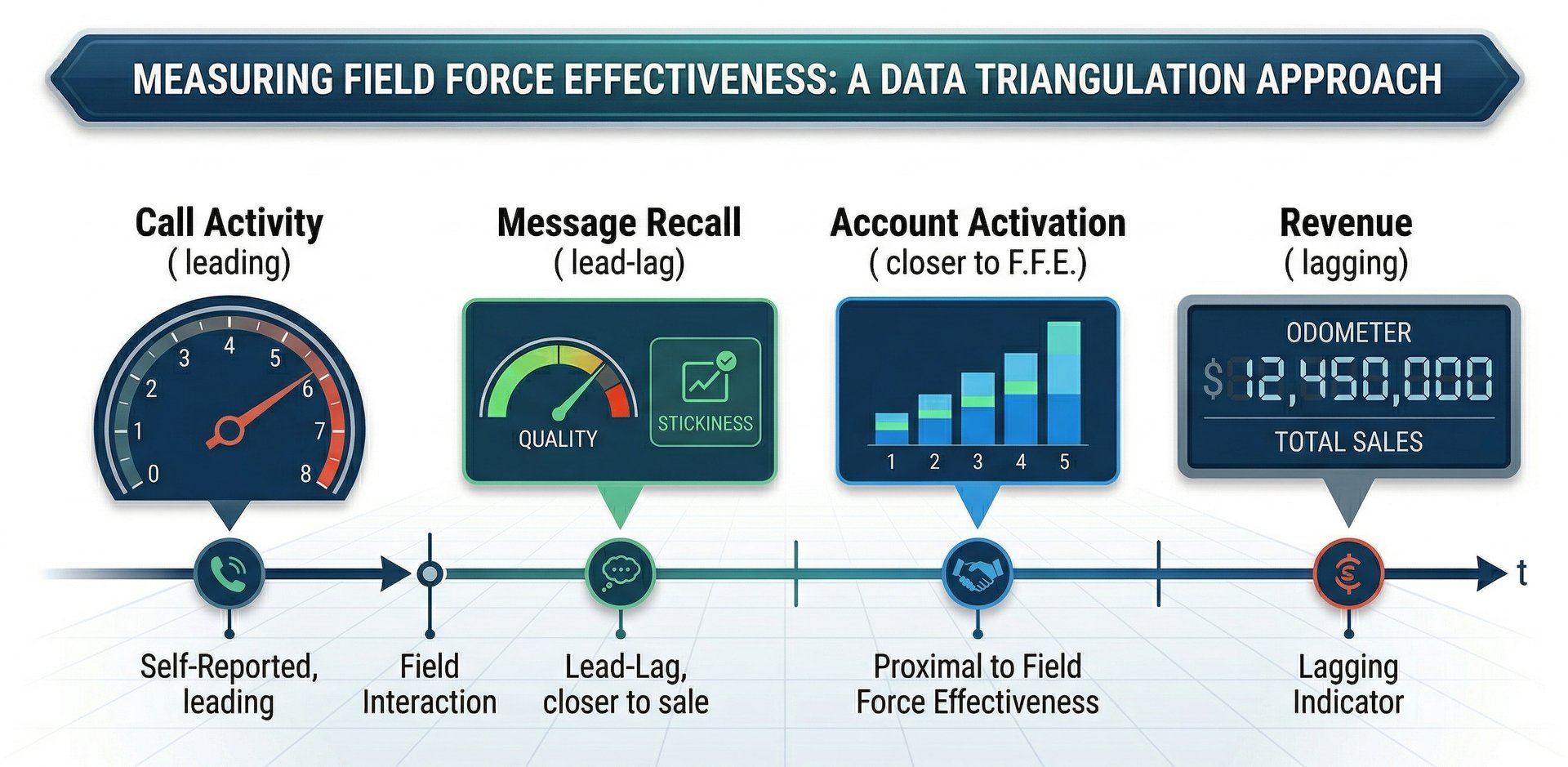
TL;DR: You should not measure field force effectiveness using either activity or revenue alone due to their limitations of being self-reported and/or the latter's lagging nature. The only practical way is to triangulate: use secondary data to track changes in account-level behavior and primary research to assess whether your message is recallable. There is no perfect attribution, but the goal is to be directionally right by consistently linking engagement to observable market movement.
The Measurement Problem: Activity vs. Outcomes
Measuring field force effectiveness sounds straightforward until you actually try to do it. On one end, you've got activity. Calls, reach, frequency. Easy to track, but a lot of it is self-reported and tied to incentives, so it's never quite clean. And even if it were, it still doesn't tell you much. A rep can make a lot of calls, and nothing changes. On the other end, you've got revenue. That's real. But revenue isn't just driven by the field force. Payers, competitors, patient flow, brand maturity, all of it is in the mix. So when you see growth, you don't really know how much came from the rep versus everything else. You end up with a lot of data, and none of it cleanly answers the question you actually care about: did anything change because the rep showed up?
Using Secondary Analytics to Track Behavior Change
The way I've seen this work best is by going down to the account level. Take your claims or sales data and follow individual physicians or accounts over time. Layer in your CRM data. Now you can see when an account was called on and what happened after. Simple questions: When did we engage this account? How often? What did their prescribing look like before and after? Did anything move? After enough accounts, patterns show up. Some start prescribing after a couple of interactions, some take longer, some don't move at all. You can even estimate how many calls it typically takes to activate an account and whether that number differs across territories.
Account activation is where things get interesting. When a doctor who wasn't prescribing suddenly starts, that's gold. It might not scale immediately, but it's usually the first sign you're getting somewhere. It's not perfect, and you can't prove causality, but it's a lot more grounded than "we made 100 calls" or "sales went up." What is more important is that it helps you think better. If one territory needs twice as many interactions to get the same outcome, you start asking why. Access? Messaging? What type of accounts are we going after?
Where Primary Research Fits
Primary research is still useful here, just for a different reason. If you want to know whether your message is landing, you have to ask physicians directly. Message recall is the simplest way. Can HCPs tell you what your product does? Do they remember anything specific? If they can't, it doesn't matter how many times your reps met with them. Something isn't sticking. While this kind of research doesn't scale, since you can't run enough interviews to evaluate 80 or 90 territories individually (sample sizes get too small and the data becomes unreliable), it is still worth looking into.
So use primary research to understand the overall quality of your messaging. Use secondary data to understand what's actually happening in the market at a more granular level. Also worth being clear about what level you're measuring. National questions are very different from territory questions. And once you go down to the rep level, context matters a lot; some reps are working in harder environments than others, and if you don't account for that, your comparisons won't be apples to apples.
Closing Thoughts
There's no clean way to isolate exactly how much impact a rep had, and that is okay, since too many factors are at play that ultimately affect a product's sale. However, what you can do is get directionally right by looking at outcomes, account-level movement, overlaying your field activity, and using primary research to check whether your message even makes sense to physicians. If you do that consistently, you will notice patterns emerge that will help you make better decisions. That's the goal, just enough clarity to know whether what you're doing is working.